10.09.2026
PEP Ecopassport Association
When a manufacturer sets out to develop a PEP, they quickly encounter two acronyms that structure the entire methodological process: PCR and PSR. These two levels of rules are not redundant; they address two different needs. Understanding how they interrelate helps avoid a great deal of back-and-forth during the execution of an LCA.
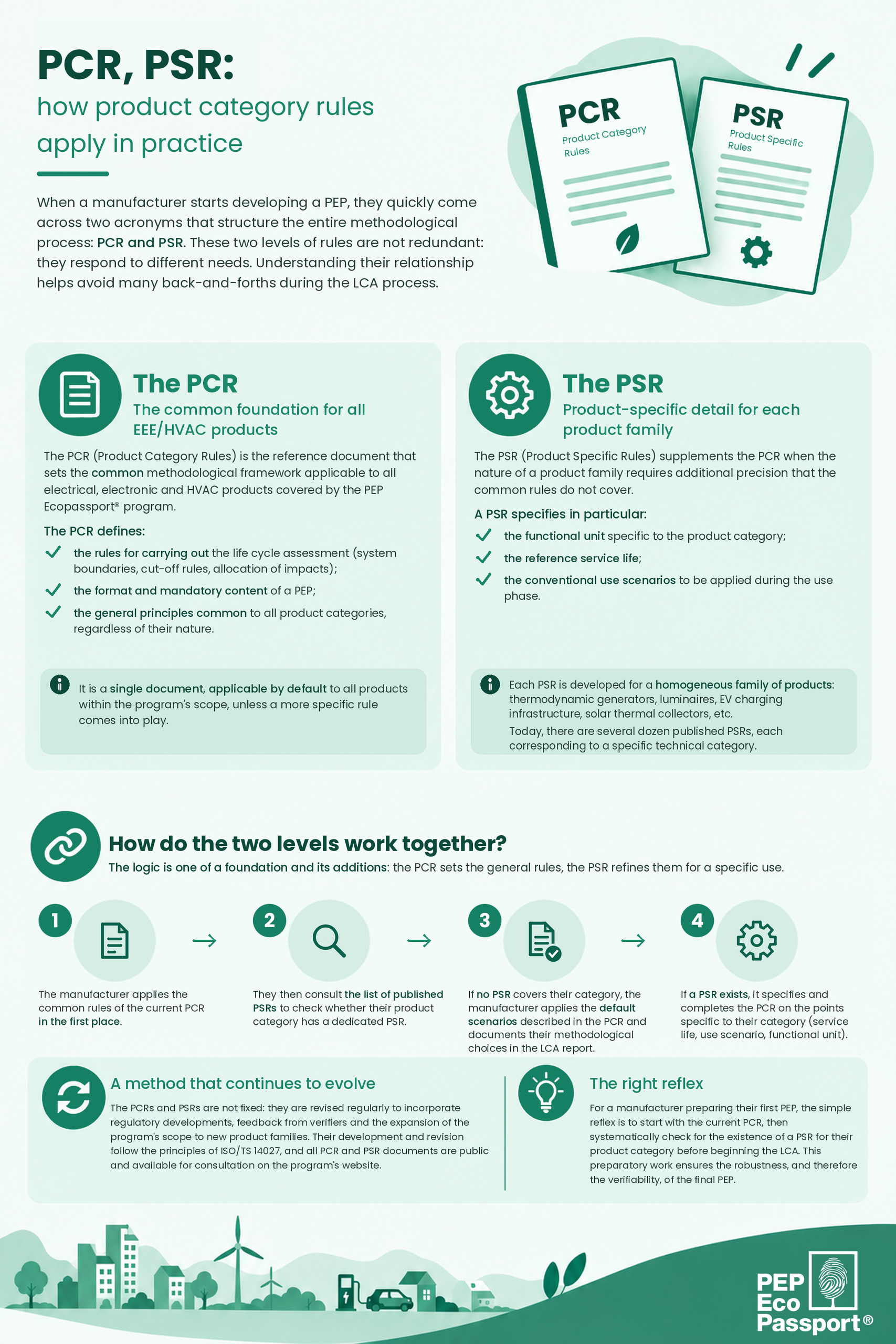
The Product Category Rules document serves as the reference establishing the common methodological framework applicable to all electrical, electronic, and HVAC products covered by the PEP Ecopassport® program.
In particular, the PCR defines:
It is a single document, applicable by default to any product within the scope of the program, unless supplemented by a more specific rule.
Product-Specific Rules complement the PCR when the nature of a product family requires specific details that common rules cannot cover.
In particular, a PSR details:
Each PSR is developed for a homogeneous product family: thermodynamic generators, lighting fixtures, electric vehicle charging infrastructure, solar thermal collectors, etc. Today, there are dozens of published PSRs, each corresponding to a specific technical category within the EEE/HVAC sector.
The approach is based on a core framework and its supplements: the PCR sets out the general rules, while the PSR refines them for a specific application.
In practical terms, to develop a PEP:
This two-tier architecture ensures the program remains consistent, providing a single methodological foundation for the entire EEE/HVAC sector, while accommodating the actual diversity of the products covered, ranging from hot water tanks to electric vehicle charging infrastructure.
PCRs and PSRs are not static; they are regularly revised to incorporate changes in standards, feedback from verifiers, and the expansion of the program’s scope to include new product families. Their development and revision follow the principles of the ISO/TS 14027 standard, and all PCR and PSR documents are publicly available on the program’s website.
For a manufacturer preparing its first PEP, the logical approach is simple: start with the current PCR, then systematically check whether a PSR exists for the specific product category before launching the life cycle assessment. This preparatory work determines the robustness—and therefore the verifiability—of the final PEP.