01.10.2026
PEP Ecopassport Association
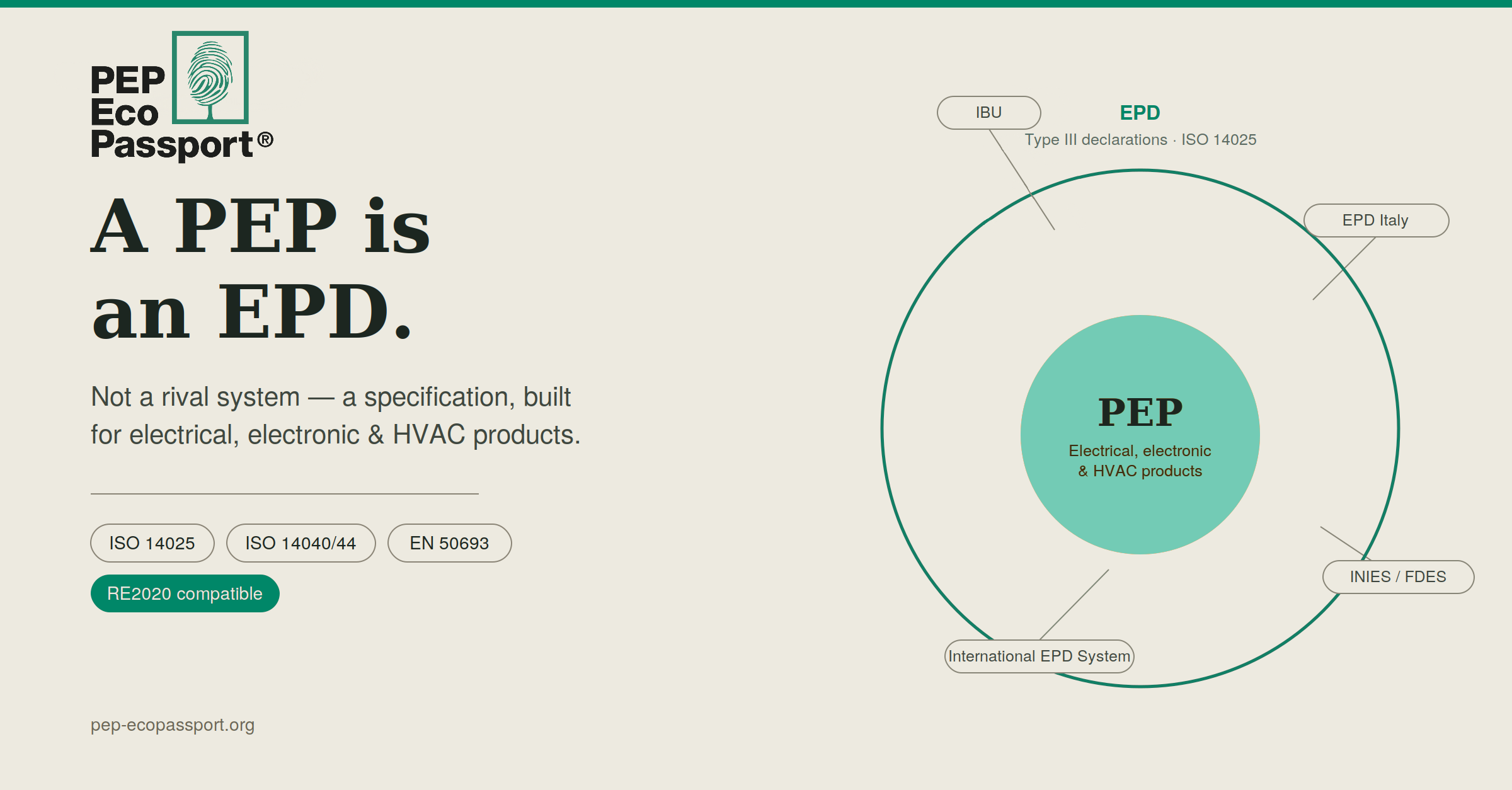
In practice, the terms “PEP” and “EPD” are often used as if they referred to two competing systems. In reality, there is no rivalry between the two: a PEP is an EPD. More precisely, a PEP is the declaration produced under the PEP Ecopassport® program, which is itself one of the international programs for creating EPDs.
An EPD (Environmental Product Declaration) is a standardized document that presents, in a transparent and verified manner, a product’s environmental impacts across its entire life cycle. It is also classified as a “Type III” environmental declaration under the international standard ISO 14025. This standard establishes the principles and procedures for developing this type of declaration, which is primarily intended for business-to-business communication.
In practical terms, an EPD is always based on the same foundations:
The term “EPD” therefore refers to a family of standards, not a specific program. There are numerous EPD programs worldwide, such as the International EPD System, IBU, EPD Italy, and, for construction products in France, the INIES program with its FDES declarations.
The PEP (Product Environmental Profile) is the environmental declaration issued under the PEP Ecopassport® program. It serves, in effect, as the environmental “identity card” for an electrical, electronic, or HVAC (heating, ventilation, and air conditioning) product. The PEP meets the exact requirements of an EPD:
In France, this recognition has very tangible implications: the PEP Ecopassport® program has an agreement with the Ministry of Housing (DHUP), allowing PEP data to be used in building life cycle assessments required under the RE2020 environmental regulations. Furthermore, PEP data is automatically transmitted to the INIES database.
While every PEP is an EPD, the reverse is not true: not all EPDs are PEPs. The distinction lies at two levels:
In other words, saying “PEP” is equivalent to saying “EPD produced within the PEP Ecopassport® program framework for an EEE or HVAC product.” It is a specification, not an exception.
Understanding that the PEP is an EPD allows the program to be placed in its international context without downplaying its specific nature. This dual positioning is what makes the PEP Ecopassport® program strong:
For manufacturers in the EEE/HVAC sector, publishing a PEP means producing a globally recognized EPD while benefiting from a methodological framework designed specifically for their products, one that can be directly utilized for French regulatory requirements like RE2020.
| EPD | PEP | |
| Nature | Normative concept (ISO 14025) | Concrete declaration resulting from a program |
| Scope | All product categories, all programs | Electrical, electronic, and HVAC products |
| Framework | General Type III standard | PEP Ecopassport® program (PCR/PSR, EN 50693) |
| Relationship | Family | Subset : a PEP is an EPD |